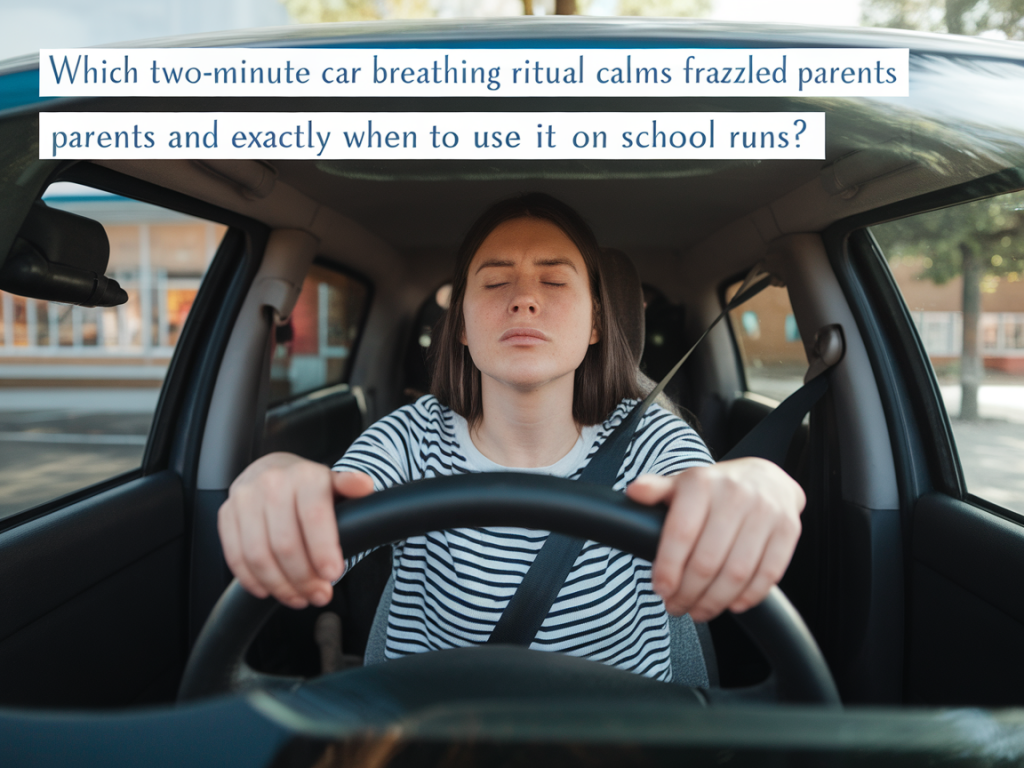
There are mornings when the school run feels like a relay race against time, where every small delay becomes a crisis and my breath lives in the shallow, panicked part of my chest. Over the years I’ve learned that taking two minutes to breathe—properly—can change the tone of the whole trip. I want to share the exact two‑minute car breathing ritual I use, why it works, and the best moments to use it on school runs so you don’t arrive at the classroom feeling frazzled.
Why two minutes? Why the car?
Two minutes is short enough to be realistic between the chaos of backpacks and last-minute snack hunts, but long enough to shift your nervous system away from stress. Research shows that even brief periods of slow, focused breathing reduce heart rate, lower cortisol, and improve emotional regulation. In a parked car, you have a small, contained space that acts like a mini sanctuary—no one expects conversation, engines are off, and the seat gives you a stable posture to make the breathing more effective.
The exact two‑minute breathing ritual (step by step)
This is what I do, word for word, when I need to come back to myself before we drive off.
- Park safely: Pull over in a safe spot or stay parked with the engine off in the drive. Switch the handbrake on and put the keys down. I close the car door and give myself permission to pause.
- Set a gentle timer: Use your phone’s timer or a simple app like Calm or Insight Timer set for two minutes. The soft ticking away removes the need to watch the clock.
- Place your feet flat: Feet on the car floor, hip-width apart. This helps ground you physically.
- Hands to your belly: Rest one hand on your chest and one on your belly. The lower hand helps you feel the diaphragm working.
- Slow 4-6 breath count: Inhale for 4 counts through the nose, feeling your belly rise, hold for 1–2 counts, then exhale for 6 counts through slightly parted lips. Repeat this pattern for two minutes.
- Finish with a mindful scan: After the two minutes, take a single, normal breath, then do a quick 10–20 second mental scan: notice your jaw, shoulders, and neck—soften where you can.
Why this pattern works
Lengthening the exhale (6 counts) signals the parasympathetic nervous system—the body’s "rest and digest" mode—to come back online. The hand on the belly gives tactile feedback so you breathe diaphragmatically rather than shallowly. Holding briefly between inhale and exhale prevents hyperventilation and helps you feel centred. Two minutes is a sweet spot: it’s long enough to feel an effect but short enough to be used often.
When to use it on school runs
You don’t need to wait for a meltdown to start this ritual. Here are the practical moments when I use it.
- Before we get into the car: If the house left you all flustered—missing shoes, spilled cereal—two minutes in the parked car calms the immediate adrenaline so the drive isn’t tense.
- After an argument: If there was a disagreement at the door, I open the car, sit, do the ritual, and then speak. It stops me from answering in a raised voice or being short with teachers later.
- If traffic is heavy and the stress creeps in: If we’re stopped safely (not in moving traffic), a quick two minutes while the kids have a quiet activity in the back can soothe me before we inch forward.
- As a buffer before handover: Five minutes before we park at the school, I do the ritual to make sure I’m calm at the gate—less rushed goodbyes help everyone’s day start better.
How to make it kid‑friendly (and get them involved)
Sometimes my children ask to join. There are gentle ways to include them without turning the moment into a lesson.
- Call it a “quiet breath” game—kids respond to playful language. We breathe together for one minute, then I finish for the second minute.
- Use a soft, slow counting voice or a simple app with a chime so they don’t need to watch the screen.
- Offer a small, tangible reward like a sticker if they sit quietly during the minute—it helps establish the habit without pressure.
Variations to suit your needs
Not every morning is the same. Here are ways I adapt the ritual.
- Shorter reset: If two minutes feels impossible, do one full three-second inhale and a five-second exhale for five rounds (about 40 seconds).
- Visual focus: Look at a small object—like a sticker on the dashboard—or a calming landscape outside to pair breathing with a visual anchor.
- Box breathing for high stress: If I feel particularly wound up, I use box breathing: inhale 4, hold 4, exhale 4, hold 4—repeat for two minutes.
Small practical tips and helpful tools
A few simple things make this ritual easier to keep up.
- Keep a soft travel cushion or rolled towel to support your lower back; better posture improves diaphragmatic breathing.
- Use a subtle car diffuser with calming scents like lavender or bergamot (I like Neom’s real aromatherapy ranges) but avoid strong fragrances if your child is sensitive.
- Apps like Headspace, Calm, or free timers with gentle chimes make the ritual feel like a small treat rather than a chore.
- If you’re short on parking time, do a 60‑second breathing mini‑reset focused on a long exhale—still effective.
How you’ll know it’s helping
The first few times you’ll notice small shifts: your shoulders drop, your voice softens, you don’t snap at the child who forgot their bag. Over weeks, those two-minute pauses become a predictable habit that lowers baseline stress, making mornings less fragile. For me, the real change has been in how I show up—not perfect, but steadier, kinder, and more able to meet small emergencies without unraveling.
| Morning moment | Ritual length | Why it helps |
|---|---|---|
| Before leaving the house | 2 minutes | Creates calm baseline; prevents chain-reaction stress |
| After a disagreement | 2 minutes | Stops reactive replies; allows thoughtful words |
| Stuck in traffic (parked) | 1–2 minutes | Reduces immediate tension; avoids road‑rage escalation |
| Five minutes before school | 2 minutes | Smoother handover; kinder goodbyes |
Try this ritual three mornings in a row and notice what changes. If you forget, treat the slip gently—habit forms from gentleness, not guilt. The car can become a quiet doorway in the middle of busy family life: two minutes there can make the difference between a frazzled morning and one that starts with a small, steadying breath.