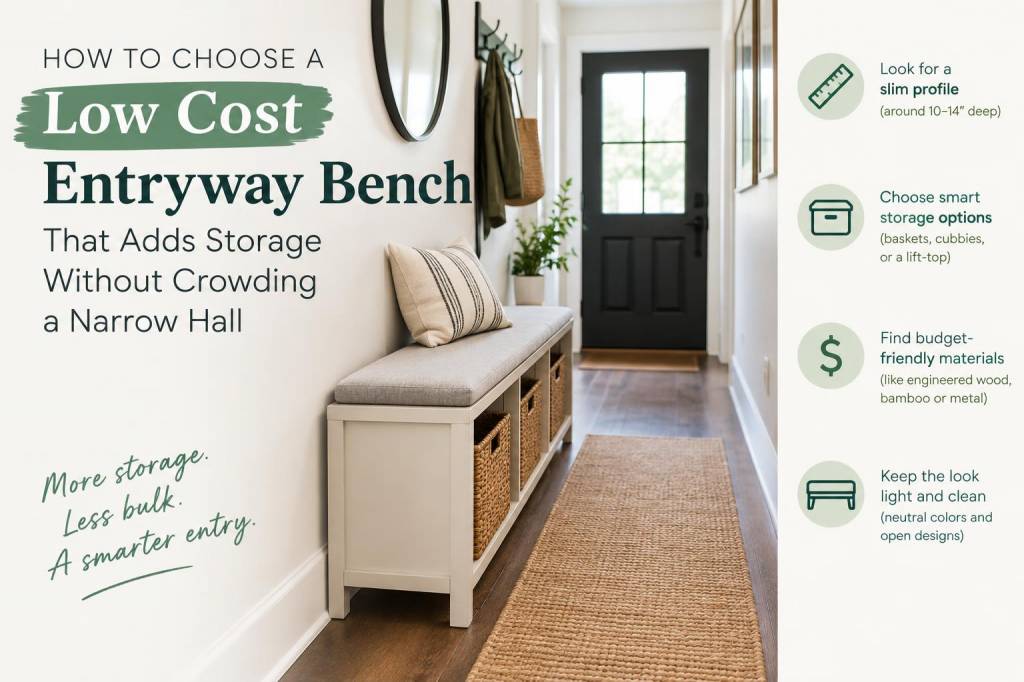
When I started looking for a bench for my own narrow hall, I made the same mistake many people do: I focused on style first and scale second. A pretty bench can still feel wrong if it blocks a doorway, steals light, or turns a slim passage into an obstacle course. In a tight entryway, every inch matters, so I learned to treat a bench less like a decorative extra and more like a piece of working furniture with a very specific job.
For me, that job was simple: give me a place to sit, hide a few everyday items, and keep coats, shoes, and bags from taking over the floor. I wanted storage, but I did not want bulk. I also wanted something affordable, because entryway furniture can become surprisingly expensive once storage is added. After a lot of measuring, comparing, and rearranging, I found that a low-cost bench can work beautifully in a narrow hall if you choose with restraint and plan for real life rather than showroom perfection.
Start with measurements, not shopping
I always begin with a tape measure. A narrow hall can look roomy until a piece of furniture arrives and suddenly feels much larger than expected. I measure width, depth, and clearance around doors, radiators, skirting boards, and any awkward corners. I also check how far a door swings open and whether the bench will interfere with foot traffic during busy moments like leaving for work or coming home with shopping bags.
In my experience, a bench with a shallow footprint usually works far better than a deep one. If your hall is especially tight, aim for a depth that lets someone sit comfortably without pushing too far into the walkway. I also leave a small visual margin, because furniture that technically fits can still feel cramped if it sits flush against every wall and edge.
I like to use painter’s tape on the floor to map out the bench size before buying anything. It sounds a little fussy, but it has saved me from several poor choices. Once I can walk around the taped shape without bumping my hips or brushing my knees, I know I am on safer ground.
Choose storage that suits your daily habits
Storage sounds useful in every case, but not all storage works equally well in a narrow hall. I prefer a bench that stores the things I reach for every day rather than a deep hidden space that becomes a dumping ground. If I can open it easily, use it quickly, and keep it tidy without effort, it earns its place.
There are a few storage styles I keep returning to:
- Open cubbies for shoes, baskets, and school bags
- Lift-up lids for scarves, gloves, dog leads, or spare umbrellas
- Drawers for smaller items that would otherwise get lost
- Mixed storage with one open section and one closed section
Open cubbies are often my favourite for a narrow hall, because they feel lighter than a solid block of doors and panels. They also make it easier to see what is inside. That said, if your household tends to create visible clutter, a closed bench may suit you better. I have found that a bench with one concealed compartment and one open shelf can strike a very practical balance.
Look for a shape that feels visually light
A bench does not have to be tiny to feel suitable for a narrow space, but it should look as though it belongs there. I pay close attention to legs, lines, and materials. A bench raised on slim legs often looks less heavy than one that sits as a solid block on the floor. That little gap beneath the seat can make a hallway feel more open, because light passes through and the floor remains visible.
I also prefer simple shapes over bulky details. Thick arms, oversized backs, and chunky sides can crowd a narrow hall very quickly. If I want a calm, uncluttered look, I choose a bench with straight lines and a modest profile. Even a plain design can feel warm and welcoming when paired with a cushion, a woven basket, or a small piece of art above it.
Colour matters too. In my home, lighter finishes tend to help small spaces feel less squeezed, but I do not think everything must be pale. A darker bench can still work if the room has enough natural light or if the piece has slim proportions. What I try to avoid is a dark, heavy-looking bench with a wide footprint, because that combination can make a hall feel narrower than it really is.
Think about seating comfort as much as storage
I used to think any bench would do as long as it had storage, but comfort makes a real difference. If I am putting shoes on while balancing a bag and trying not to block the door, I want a seat that feels stable and easy to use. A bench that is too low can be awkward, while one that is too high may not feel relaxed for everyday use.
The seat surface matters as well. A smooth wooden top can look lovely, but I often add a cushion if I expect to sit there often. For a narrow hall, I like a cushion that stays slim rather than one that bulges outward. A thick cushion can eat into seating space or make the bench appear larger than it is. Firmness is useful here too, because a very soft cushion may look inviting but can make the bench less practical for quick daily routines.
If children, older relatives, or guests will use the bench, I think about ease of sitting and standing. A stable, sturdy bench with enough room for someone to sit without twisting sideways is worth more than a decorative piece that looks lovely but feels inconvenient in practice.
Materials that make sense for a lower budget
When I am shopping on a budget, I try to separate appearance from structure. Some affordable benches are made from particleboard or engineered wood, and that can be perfectly fine if the design is solid and the finish is durable. I look closely at weight capacity, hinge quality, and how the piece is joined together. A low price is not useful if the bench wobbles after a few months.
I have had good results with painted wood finishes, laminate surfaces, and metal frames with simple storage baskets. Each has its strengths. Painted finishes can look fresh and quiet in a hall. Laminate is often easy to wipe clean, which matters when muddy shoes are involved. Metal frames can feel lighter visually, especially when paired with woven storage below.
If I want a bench that feels more expensive than it is, I look for a good balance of texture and simplicity. A straightforward frame, a neat storage solution, and one thoughtful detail, such as a slatted shelf or woven basket front, can make a low-cost piece feel much more considered.
Small details that make a narrow hall work harder
Once the bench is in place, the surrounding details matter just as much. I have learned that a narrow hall functions better when every item earns its spot. A bench with storage becomes more useful if I pair it with a hook rail above it, a wall shelf for keys, or a shallow tray for mail. That way, items do not spread across every surface in the room.
I also keep a few rules for myself:
- Store only everyday items in the bench
- Keep shoes to a small rotating selection
- Use baskets to group loose objects
- Leave one section empty so the space can breathe
Leaving some storage space unused may sound odd, but it helps a narrow hall stay calm. When every compartment is packed full, the room starts to feel busy and heavy. A little breathing room makes a surprisingly large difference.
| Feature | What I prefer in a narrow hall | Why it helps |
|---|---|---|
| Depth | Shallow footprint | Leaves walking space open |
| Base | Slim legs or open bottom | Makes room feel lighter |
| Storage | Easy-access cubbies or one lift-up section | Keeps daily items close without clutter |
| Finish | Simple, easy-care surface | Handles mud, dust, and daily use |
| Seat | Stable, comfortable height | Makes sitting and standing easier |
Where I save money without sacrificing usefulness
I rarely spend extra on features I will not use. For example, if a bench has a fancy backrest but sits against a wall, that money is better spent elsewhere. I also do not pay more for storage that is awkward to reach. A bench should simplify my routine, not create a new one.
Second-hand shops, online marketplaces, and seasonal sales can be excellent places to look. I have seen sturdy benches at very reasonable prices, especially when I am willing to clean, repaint, or replace a cushion. If I find a piece with good proportions and solid structure, I can usually improve the look with a little care rather than buying something more expensive from scratch.
I also think about long-term flexibility. A bench that can later move into a bedroom, utility room, or landing is a smarter buy than one that only works in a single narrow corner. That kind of adaptability matters when I want to keep spending sensible.
A simple final check before buying
Before I make a decision, I ask myself a few honest questions: Will I still have enough room to walk past it easily? Will it help or hinder the morning rush? Can I keep it tidy without much effort? Does it suit the scale of the hall rather than overpowering it? If I cannot answer yes to those questions, I keep looking.
I have found that the right low-cost entryway bench is rarely the flashiest one. It is usually the one that respects the room, fits the rhythm of daily life, and quietly solves more than one problem at once. In a narrow hall, that kind of calm usefulness matters far more than a dramatic statement piece.